
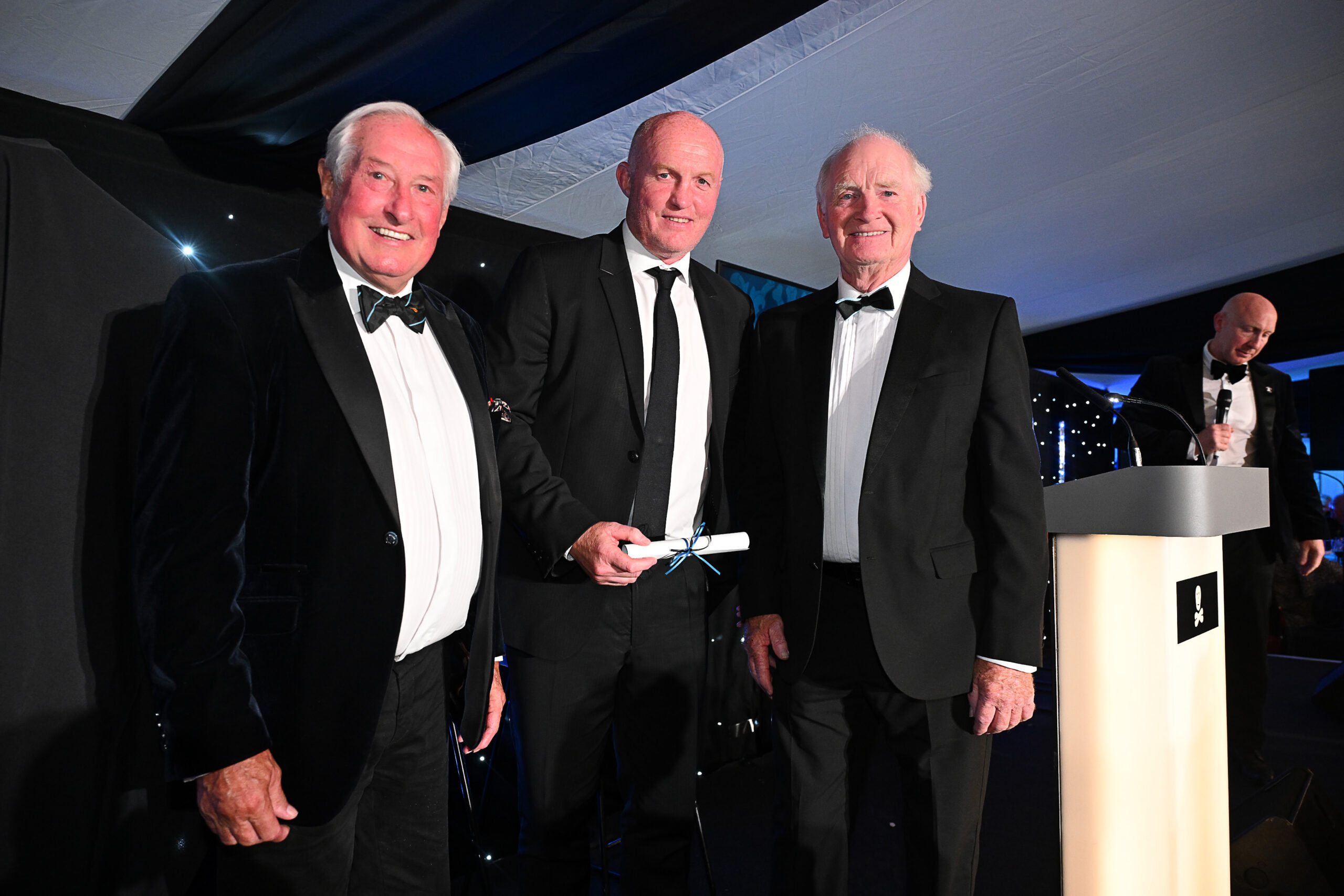
Sixteen legendary players were inducted into the Cardiff RFC Hall of Fame on Saturday night as the club celebrated its 150th anniversary at a Gala Dinner.
One player from each decade of the Blue & Blacks existence were chosen by a special selection committee.
WD Phillips was the first induction, with the likes of Roger Lane, Bob Lakin, Taufa’ao Filise and Lloyd Williams in the audience to collect their awards from Cardiff Rugby President, Sir Gareth Edwards, and Cardiff Athletic Club President Mervyn John.
W D (Bill) Phillips – 1870s
Affectionately known as the ‘Father of the Club’, Cardiff-born Bill Phillips was a founder member and leading figure of the Cardiff Wanderers, the side that merged with Glamorgan FC to form Cardiff Football Club in 1876.
Initially playing at back, Phillips moved to the forwards in his mid-twenties and became known as a tough and uncompromising player. He made 109 appearances for Cardiff across nine seasons between 1876 and 1885, scoring 51 tries and one drop goal, including appearances against New Zealand and South Africa.
Phillips won five Welsh caps, while also featuring in two non-cap internationals. His contribution to the club extended far beyond the playing field, serving on the Cardiff committee from 1876 until his death in 1918. He was also a WRU committee member and vice-president, as well as a member of the International Board between 1887 and 1907.
Frank Hancock – 1880s
Francis Escott ‘Frank’ Hancock moved to Cardiff from his native Devon in 1884 as director of his family’s brewing business. Already an established Somerset player, he made his Cardiff debut against Cheltenham College in February 1884, scoring two tries.
His impressive performance led Cardiff to change their established formation to accommodate him for the following match against Gloucester. The club moved from three to four three-quarters, helping to establish the four three-quarter system that would become a defining feature of Cardiff rugby in the years that followed.
Hancock made 50 appearances for Cardiff between 1884 and 1886, scoring 35 tries, and captained the side during the 1885–86 season. His influence on the development of the game was later recognised when both Hancock and Cardiff were inducted into the World Rugby Hall of Fame.
Percy Bush – 1890s
Canton-born Percy Bush became one of Cardiff’s greatest early stars, making 171 appearances between 1899 and 1910 and scoring 66 tries and 35 drop goals.
Known as the ‘Prince of Dodgers’, the outside-half was regarded as one of the finest half-backs of his generation. He captained Cardiff for three seasons, a period which included victories over South Africa and Australia, as well as the club’s unbeaten 1905–06 season.
During his captaincy, Cardiff won 82 of 95 matches, giving Bush an impressive 86 per cent win rate. He won eight Welsh caps and played in the famous 1905 victory over New Zealand.
Bush was also a pioneering British Lion, touring Australia and New Zealand in 1904. He scored 100 points on the tour, including 12 tries, appeared in all four Tests and remains the record-holder for drop goals in a Lions series.
Johnny Williams – 1900s
Born in Whitchurch, Cardiff, Johnny Williams was one of the most prolific try-scorers in the club’s history. The winger played 199 matches for Cardiff between 1903–04 and 1910–11, scoring 150 tries – a club record that stood for 40 years.
Williams captained Cardiff in 1909–10 and featured in victories over South Africa and Australia, scoring one try against the former and two against the latter. He won 17 Welsh caps between 1906 and 1911, enjoying three Grand Slam seasons and losing just twice.
He was also joint Wales record try-scorer alongside Reggie Gibbs, averaging a try per match until the record was eventually surpassed by Sir Gareth Edwards in 1976. Williams toured New Zealand and Australia with the Anglo-Welsh ‘Lions’ in 1908, appearing in two Tests and finishing as the tour’s leading try-scorer.
Williams was inducted into the World Rugby Hall of Fame in 2015. His life was tragically cut short during the First World War, when he died from wounds sustained at the Battle of the Somme in July 1916.
Tom ‘Codger’ Johnson – 1910s
Cardiff-born and bred, Thomas Albert ‘Codger’ Johnson was a fearless and uncompromising player who made his Cardiff debut against Pontypridd in 1920.
Standing just 5ft 8in and weighing barely 11 stone, Johnson was described as stocky, strong and incredibly determined. Equally comfortable on the wing or at centre, he went on to make 187 appearances for Cardiff between 1920 and 1927, scoring an extraordinary 189 tries and five drop goals.
Johnson captained the club in 1924 and won 12 Welsh caps between 1921 and 1924. His defensive ability was particularly renowned, with one Scottish newspaper describing him as the finest defensive player the game had ever known.
Tommy Stone – 1920s
Tommy Stone made his Cardiff debut against Pontypool in October 1928 and went on to become one of the club’s most popular and loyal players.
Primarily a full-back, although also capable of playing at half-back, Stone was described as ‘diminutive’ but renowned for his cleverness and daring. He made an outstanding 317 appearances for Cardiff, scoring 17 tries and 12 drop goals.
Stone captained the club in 1935–36 and was regarded as one of the most popular players on any rugby ground. Despite being selected as a late replacement for Wales against Ireland in 1937, a blizzard in Belfast forced the match to be postponed. When the fixture was eventually played, the original full-back had recovered from injury, ending Stone’s hopes of winning a cap.
He later signed for Barrow Rugby League club, but remained remembered as one of Cardiff’s most dedicated servants.
Wilfred Wooller – 1930s
Wilfred Wooller was one of Wales’ greatest all-round sportsmen and a towering presence in the Cardiff midfield.
Born in Rhos-on-Sea, Wooller made his Cardiff debut against Neath in October 1936 at the age of 24. He went on to play 71 matches for the club, scoring 38 tries and 30 drop goals. His selection for Cardiff was a major draw, with his presence significantly increasing attendances wherever the team played.
Wooller won 18 Welsh caps and was a key member of the side that defeated the 1935 All Blacks. He also represented Cambridge in both rugby and cricket.
His rugby career was interrupted by the outbreak of the Second World War, including a period as a prisoner of war at Changi in Java. Despite this, he went on to enjoy an extraordinary cricket career with Glamorgan, captaining the county for 14 years and serving as secretary for 36.
Sid Judd – 1940s
Cardiff-born Sid Judd was an outstanding back-row forward who combined strength, aggression and an exceptional reading of the game.
A blindside wing-forward or number eight, Judd made 184 appearances for Cardiff across nine seasons, scoring 43 tries, 30 conversions and four penalties for a total of 201 points.
He won 10 Welsh caps between 1953 and 1955 and played in both of Wales’ victories over the All Blacks in 1953, scoring a try in each match. He also represented the Barbarians on several occasions and captained Cardiff during the 1954–55 season.
Judd’s promising career was tragically cut short by illness. Having established himself as an experienced international forward and a potential British Lions tourist, he died from leukaemia in 1959.
Geoff Beckingham – 1950s
Barry-born Geoff Beckingham was a hugely loyal Cardiff servant, making 331 appearances for the club and winning three Welsh caps.
His international opportunities were limited by the presence of the great Bryn Meredith, but Beckingham’s finest hour came in Cardiff’s legendary 8–3 victory over the All Blacks in November 1953.
The hooker’s work at scrum-time was instrumental in creating the platform for Cardiff’s two early tries, while his intervention at the end of the match proved equally crucial. With New Zealand threatening Cardiff’s line, Beckingham stole their put-in at the third scrum, allowing Cliff Morgan to clear to safety and secure one of the club’s most famous victories.
He also featured in Cardiff’s 1957 victory over Australia. Away from rugby, Beckingham worked as a municipal gardener in Barry and famously credited his remarkable fitness to pushing the town’s lone lawnmower for 15 hours a day during the summer.
Lyn Baxter – 1960s
Outstanding lock Lyn Baxter made 290 appearances for Cardiff between 1962 and 1974, scoring 31 tries.
His first appearance for the First XV came against Harlequins in April 1963, and he quickly established himself as a key member of a Cardiff side that enjoyed victories over some of the world’s leading international teams.
Baxter played in Cardiff’s 14–8 victory over Australia in 1966 and also featured for the East Wales side that held the 1967 All Blacks to a remarkable 3–3 draw.
He represented Wales on the 1968 tour of Argentina, initially in a non-cap international. In 2015, President’s Caps were retrospectively awarded to 25 players, including Baxter, finally giving him the international recognition he had long deserved.
He also represented the Barbarians on two occasions.
Roger Lane – 1970s
Roger Lane was one of Cardiff’s great club men of the 1970s. A dependable number eight, Lane made his First XV debut against Pontypool in October 1970 and went on to make 299 appearances for the club, starting all but five of those matches.
He scored 86 tries during an 11-year career at the Arms Park and became a key member of Cardiff’s back row, as well as an important figure in the club’s sevens team.
Lane’s rugby journey began at Tredegar Grammar before he attended Cardiff Training College, where he played for Abertillery during university holidays. He made his First XV debut for Cardiff after scoring a hat-trick for the club against Barry earlier that season.
He went on to win two Welsh B caps and was later included in the Rugby Network’s ‘Greatest Uncapped Cardiff XV’.
Bob Lakin – 1980s
Barry-born Bob Lakin was one of Cardiff’s great back-row forwards, making 325 appearances for the club and scoring 64 tries and 256 points.
A tough and uncompromising blindside flanker, Lakin combined physicality with strong defensive work, effective ball carrying and an ability to contribute at the lineout. He also developed a reputation for getting under the skin of opposition supporters with his willingness to test the limits of the offside laws.
Lakin captained Cardiff Youth and Welsh Youth before making his Arms Park debut against Penarth in 1978. He later represented Wales B and the Barbarians, playing for the latter against Swansea in 1981.
One of his standout moments came in the 1981 Schweppes Cup Final, when he scored the opening try and was named Man of the Match as Cardiff defeated Bridgend 14–6.
David ‘Dai’ Young – 1990s
David ‘Dai’ Young enjoyed an outstanding playing and coaching career with Cardiff. He made his club debut against Neath in October 1988 and went on to make 139 appearances, 114 of them as a starter, scoring seven tries.
A Wales international from the inaugural 1987 World Cup, Young won 51 caps between 1987 and 2002 and remains the only player to have toured with the British Lions across three different decades – 1989, 1997 and 2001. He won three Lions Test caps against Australia.
Young initially left Cardiff for rugby league, joining Leeds for a then-record fee before moving to Salford. Following the professionalisation of rugby union in 1995, he returned to Cardiff in 1996 and made a further 106 appearances before retiring.
His connection with Cardiff continued into coaching, with spells leading Cardiff Blues and Wasps, followed by a second stint with Cardiff between 2021 and 2023.
Martyn Williams – 2000s
Known throughout rugby as ‘Nugget’, Martyn Williams became one of the defining players of Cardiff’s professional era.
Williams made 226 appearances for Cardiff across 13 seasons after joining from Pontypridd in 1999. He scored 48 tries and 240 points and became the club’s first captain in the professional era, holding the role for three consecutive seasons.
His consistency was legendary, with former Cardiff coach Dai Young once saying: ‘Martyn has never ever played poorly. Some games he’s good, some games he’s very good.’
Williams went on to win 108 Welsh caps, including 100 Tests, becoming the first Welsh forward to reach a century of caps. He was also a British Lion on three tours – 2001, 2005 and 2009 – appearing in four Tests and scoring two tries.
He represented the Barbarians seven times and was awarded the MBE in 2012 for services to rugby.
Taufa’ao Filise – 2010s
Taufa’ao Filise joined Cardiff ahead of the 2006–07 season after moving from Bath and went on to become one of the club’s most durable front-row forwards.
The Tongan international made 255 appearances for Cardiff, including 195 starts, and scored nine tries. Capable of playing on either side of the scrum, Filise also made two appearances for the ‘Rags’.
Raised in Tonga and educated at Tupou College in Nuku’alofa, Filise moved to New Zealand in 2000 to join Bay of Plenty before later featuring for the Auckland Blues in Super Rugby.
He won 29 caps for Tonga and represented them at the 2007 and 2011 Rugby World Cups. His final Cardiff appearance came in the 2018 European Challenge Cup Final in Bilbao, where Cardiff defeated Gloucester 31–30.
Among his favourite Cardiff memories were the 2009 EDF triumph over Gloucester at Twickenham and the 2010 victory over Toulon. For Filise, Cardiff Arms Park became his ‘Home away from home’.
Lloyd Williams – 2020s
Lloyd Williams became part of a remarkable Cardiff rugby dynasty, following in the footsteps of his father Brynmor and alongside his brother Tom.
He first played for Cardiff against Leinster in March 2010 and went on to make 261 appearances for the club, including 179 starts. He scored 42 tries, captained the side on numerous occasions and reached both his 200th and 250th Cardiff appearances during his career.
Williams won 32 Welsh caps between 2011 and 2023, making his international debut against Argentina. Perhaps his most memorable moment came during the 2015 World Cup, when he was forced to play on the wing against England and delivered the grubber kick that allowed Gareth Davies to score under the posts, helping Wales knock the hosts out of the tournament.
After 13 seasons with Cardiff, Williams left in 2023 to join Ealing Trailfinders before moving to Worcester and eventually retiring in 2026.
His bond with Cardiff remained strong throughout, having once said: ‘I was a fan of Cardiff before playing rugby, and playing at Cardiff Arms Park was a dream.’ He added that Cardiff were his team and always would be.